B级听力四大陷阱02-索要物品
Would you please give me…
Can I have a look at…
May I have…
回答
Here you are.
Here it is.
B级十大蒙题绝招01-肯定/否定
| 项目 | 内容 | |
|---|---|---|
| 判断方法 | 听音调 | 句子音调上扬的就是一般疑问句或者反义疑问句 |
| 听开头 | 以助动词、情态动词、be动词开头的。常见的有:Are you/Can I /Can we/Can you/Could I/Could we/Could you/Did you/Do I/Do you/Have you /Is this…/May I /Shall I/Shall we/Will you/Would you 等 | |
| 回答 | 肯定 | yes/certainly/sure/ok/of course/no problem等 |
| 否定 | no/I have no idea/sorry等 | |
B级听力六大套路06-时间点/时间段/频率
when/what time
how long
how often
回答
一个具体的时间
一个时间段
描述频率的词句
回答别人的感谢
You're welcome. 不客气(最标准)
No problem. 没事儿 / 小意思(口语超常用)
Not at all. 别客气
Sure. 没事儿(很随意)
Anytime. 随时乐意帮忙
二、更礼貌、正式一点
My pleasure. 我的荣幸
It's my pleasure.
Glad I could help. 很高兴能帮到你
Happy to help. 乐意效劳
三、很口语、朋友之间
Don't mention it. 别提了,小事一桩
No worries. 没事儿 / 别放心上(澳洲、英国常用)
It's nothing. 这没什么
英文中他人寻求帮助时的常用回答
一、爽快答应(最常用)
1. Sure, no problem.
2. Of course.
3. Certainly.
4. No problem at all.
5. Yeah, happy to help.
6. Sure thing.
7. Glad to help.
8. Absolutely.
二、礼貌温和答应
1. I’d be happy to help.
2. Let me help you with that.
3. Sure, what do you need?
4. Alright, just tell me what to do.
三、无法帮忙时的委婉拒绝
1. Sorry, I’m a bit busy right now.
2. I wish I could help, but I can’t.
3. I’m afraid I can’t, sorry.
4. Maybe later? I’m occupied at the moment.
选择疑问句
回答的时候往往是从提问者提供的选项中二选一。
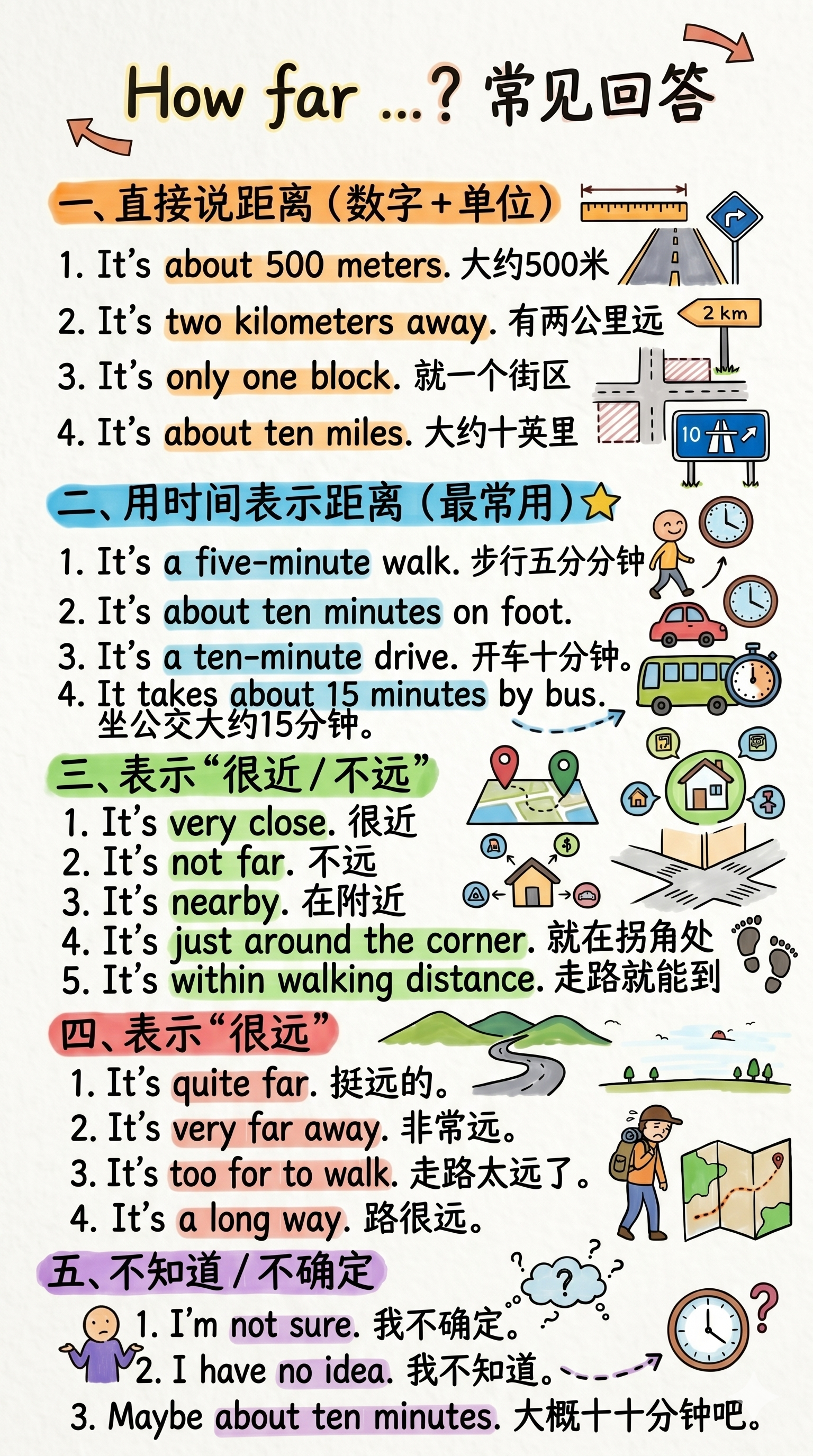
问距离 How far
一、直接说距离(数字 + 单位)
It’s about 500 meters. 大约500米。
It’s two kilometers away. 有两公里远。
It’s only one block. 就一个街区。
It’s about ten miles. 大约十英里。
二、用时间表示距离(最常用)
It’s a five-minute walk. 步行五分钟。
It’s about ten minutes on foot. 步行大约十分钟。
It’s a ten-minute drive. 开车十分钟。
It takes about 15 minutes by bus. 坐公交大约15分钟。
三、表示“很近 / 不远”
It’s very close. 很近。
It’s not far. 不远。
It’s nearby. 在附近。
It’s just around the corner. 就在拐角处。
It’s within walking distance. 走路就能到。
四、表示“很远”
It’s quite far. 挺远的。
It’s very far away. 非常远。
It’s too far to walk. 走路太远了。
It’s a long way. 路很远。
五、不知道 / 不确定
I’m not sure. 我不确定。
I have no idea. 我不知道。
Maybe about ten minutes. 大概十分钟吧。
B级十大蒙题绝招02-听到什么选什么
状语从句:省略主语和be动词
1. 主句和从句的主语相同条件1
2. 从句的谓语动词有Be动词条件2
往往可以把从句的主语和Be动词省略。
- When she主语 is谓语 walking in the park, she主语 often takes photos.
When she is主语和be动词可以省略 walking in the park, she often takes photos.
同位语从句
现在完成时的构成
被动:have/has been +过去分词
This was/is the second time→ 从句用完成时
This is the second time I have seen this movie.
这是我第二次看这部电影。
This is the third time he has called today.
这是他今天第三次打电话了。
主句是 This was the second time → 从句用过去完成时
This was the second time I had seen her.
那是我第二次见到她。
一般将来时的构成
被动:will be +过去分词